
Just a quick heads up: this website contains affiliate links, so I earn from qualifying purchases, which helps support this blog.
Most barn style garages look like a decoration, not a building. White board-and-batten, faux strap hinges, a cupola doing nothing. The ones that fit the property get three things right: silhouette, material, one good detail.
Gambrel or Gable: Pick a Roof Shape First
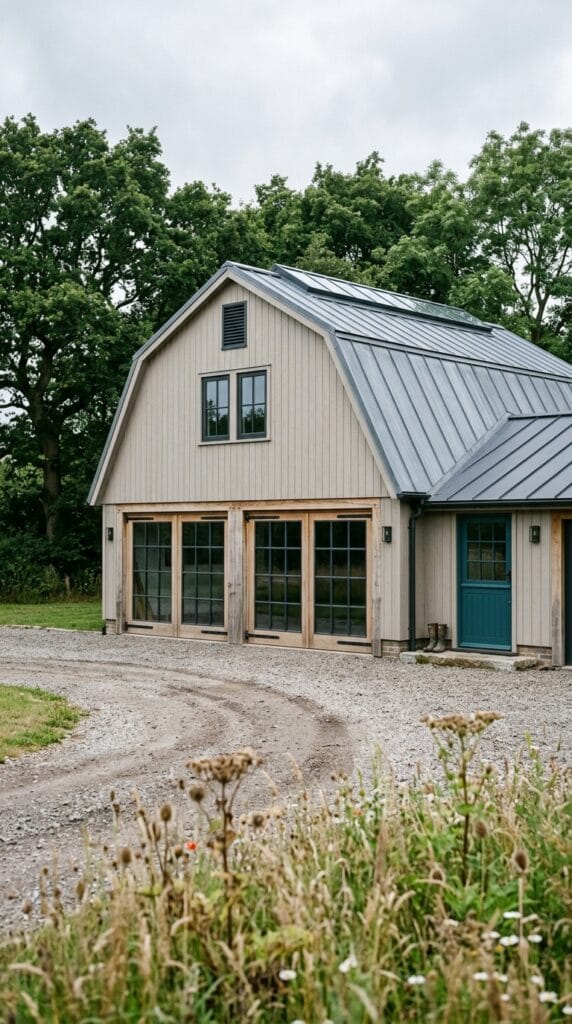
Gambrel gives you loft space. Gable gives you a cleaner line. Both say barn, but differently. Put preweathered zinc on a gambrel with timber siding below and you get the strongest silhouette from the road. Ridge skylight along the apex handles loft light. A standing-seam connector between the garage and a side bay breaks one big box into two linked forms.
Lattice Over Plinth: The New Barn Wall
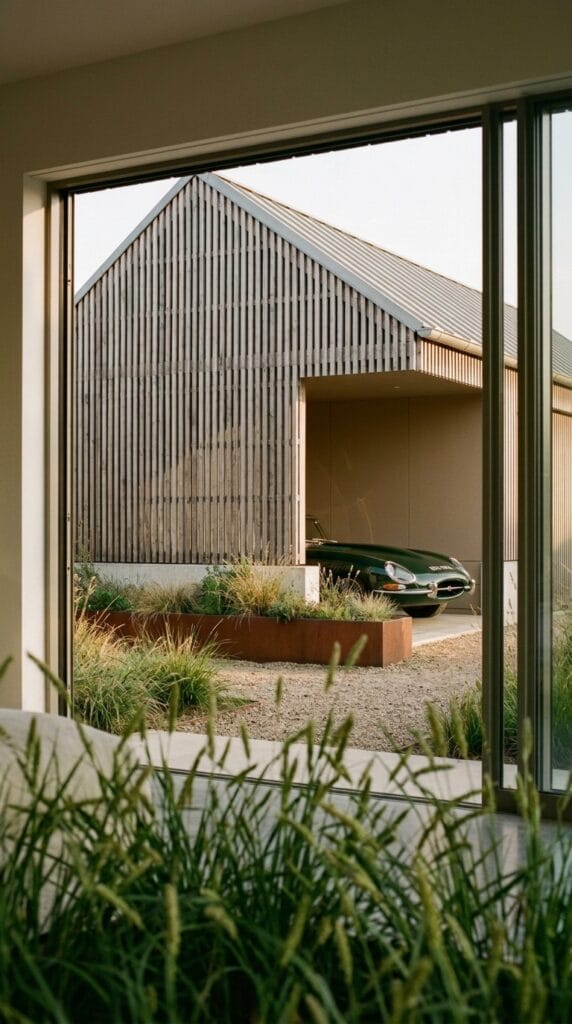
Sweet chestnut lattice cladding is the siding move replacing flat board-and-batten. The slats sit off the wall, so you get shadow lines that shift through the day and ventilation behind the skin. Timber starts silver-brown and weathers to silver-grey. The concrete plinth at the base grounds it visually and handles the hits at ground level.
Pro tip: The slat shadows change angle through the day. South-facing walls get the sharpest contrast at noon.
Black Barn Garages That Skip the Gloss
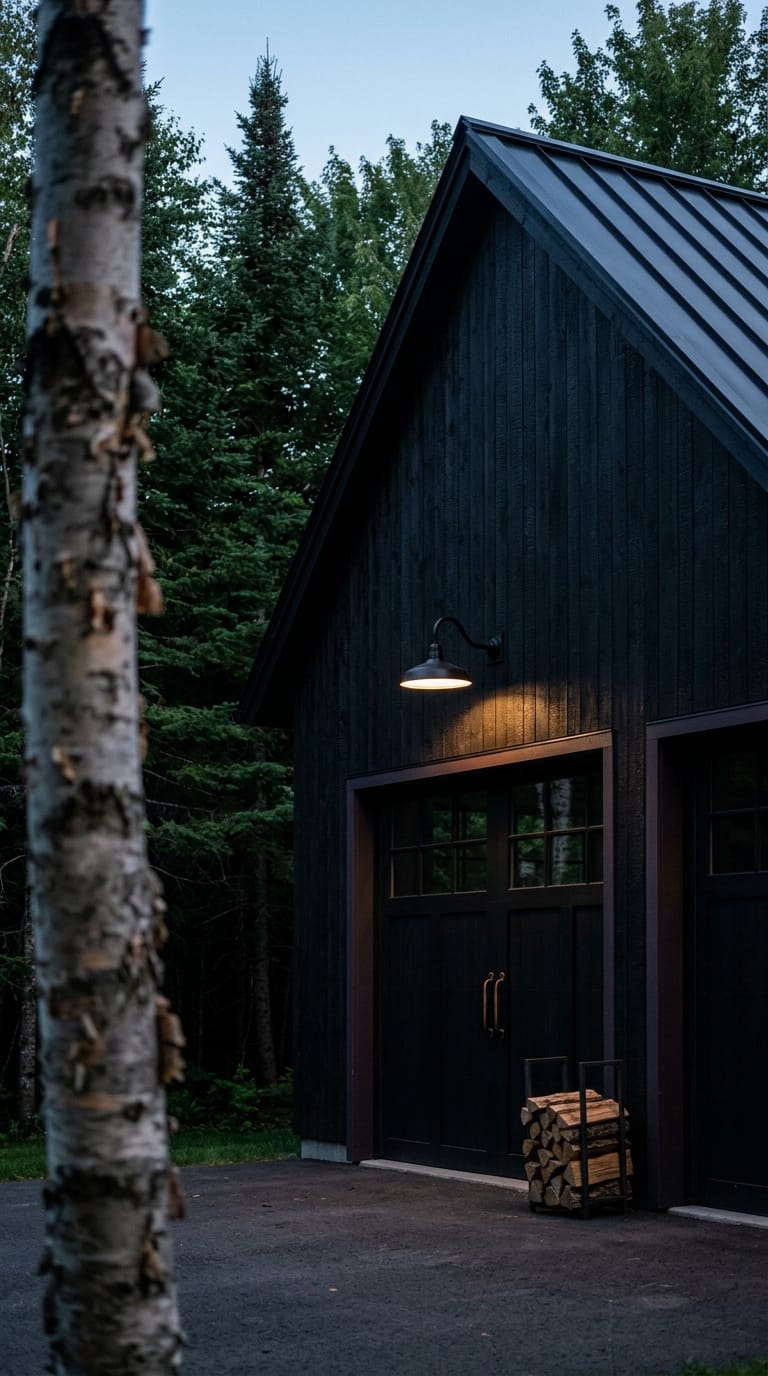
Most black barn garages online are glossy dark paint on standard siding. Looks sharp in the photo. Shows every scuff in person. The version that holds up is charred wood or matte metal. Carbon black surface that absorbs light instead of bouncing it.
Charred plank accent bays with black-framed windows. Dark bronze pull handles, not glossy strap hinges. The bronze softens the palette where shiny hardware just piles on more contrast you don’t need. Warm lighting only at the threshold and the entry door. Hit the whole facade with warm light and you undo the matte finish.
Rustic Barn Garages That Don’t Look Staged
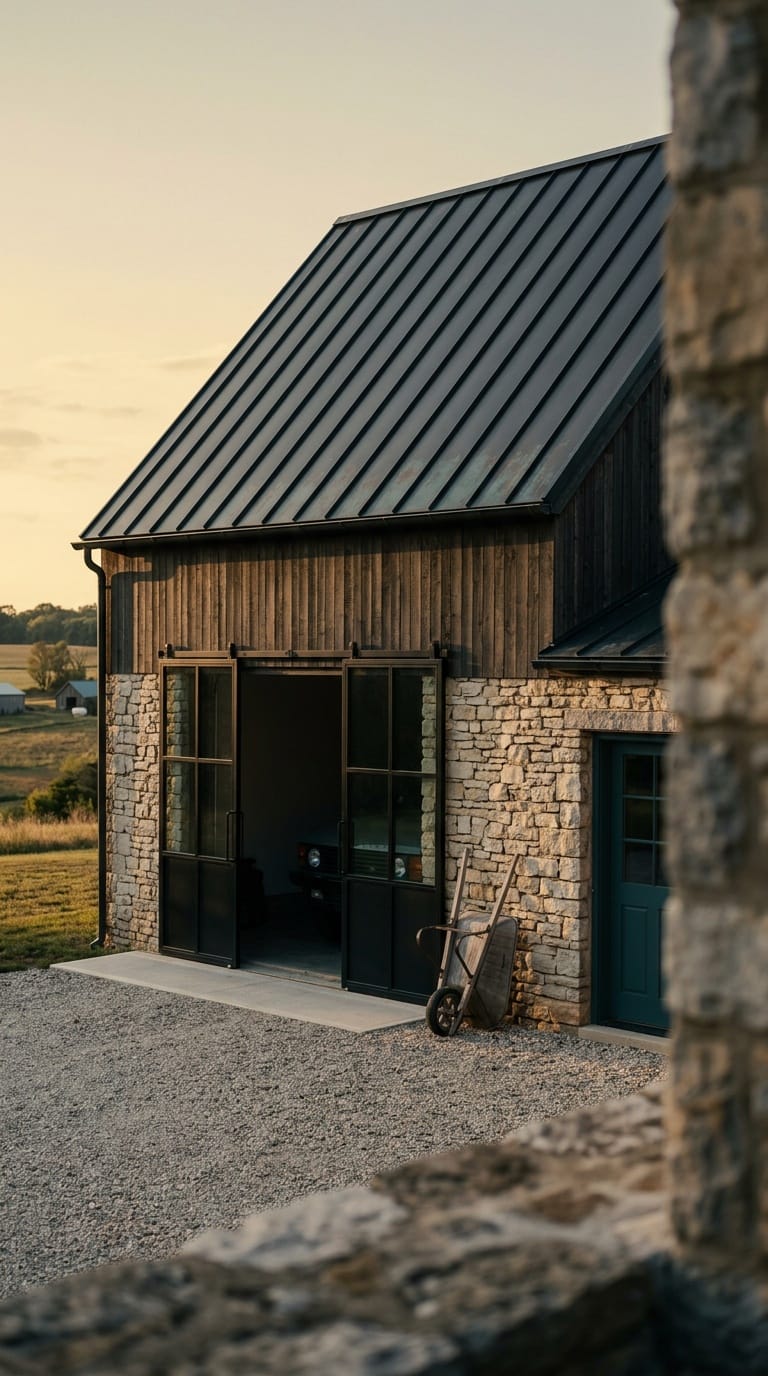
Matching stained wood. Decorative hardware. Wreath on the door. That’s what “rustic” usually means online. The ones that feel real use rough-sawn timber with visible joinery and at least one mineral surface to ground them. Concrete. Stone. Gravel.
Skip if: Your property already has a brightly painted main house. Two competing painted surfaces fight.
Carriage Proportions on a New Build
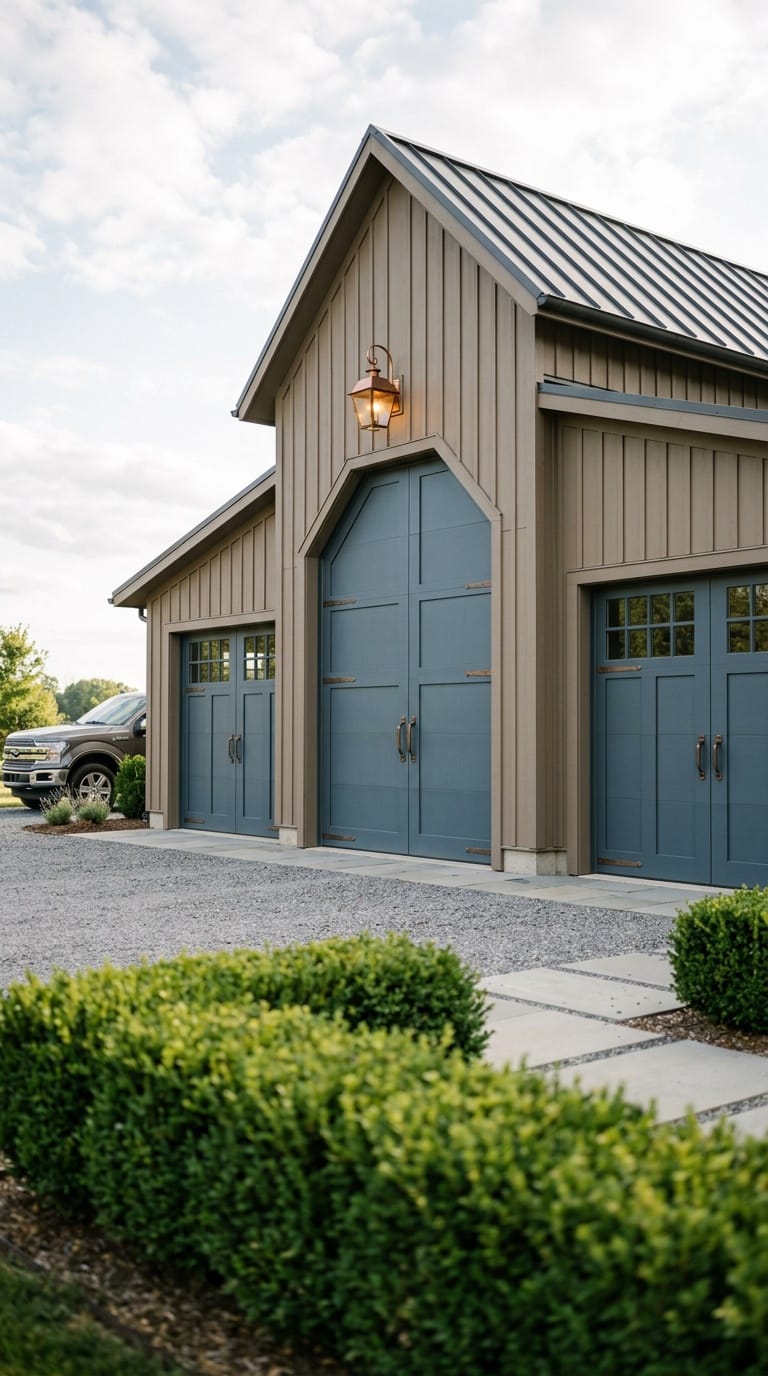
Tall central opening. Symmetrical flanking windows. Steep pitch. That’s the carriage house proportion, and it holds up on new builds with modern materials. No faux-historic trim required.
Fiber-cement flanking walls in warm mushroom. Black-framed windows. Bronze pull handles on slate blue doors. Standing-seam dark roof above. The proportions come from 19th-century carriage barns, but the materials are current: mineral, metal, glass. No wood trim to repaint every few years. One dominant opening, secondary windows kept to simple rectangles. Break that ratio and the facade loses its logic.
Pole Barn, Minus the Pole Barn Look
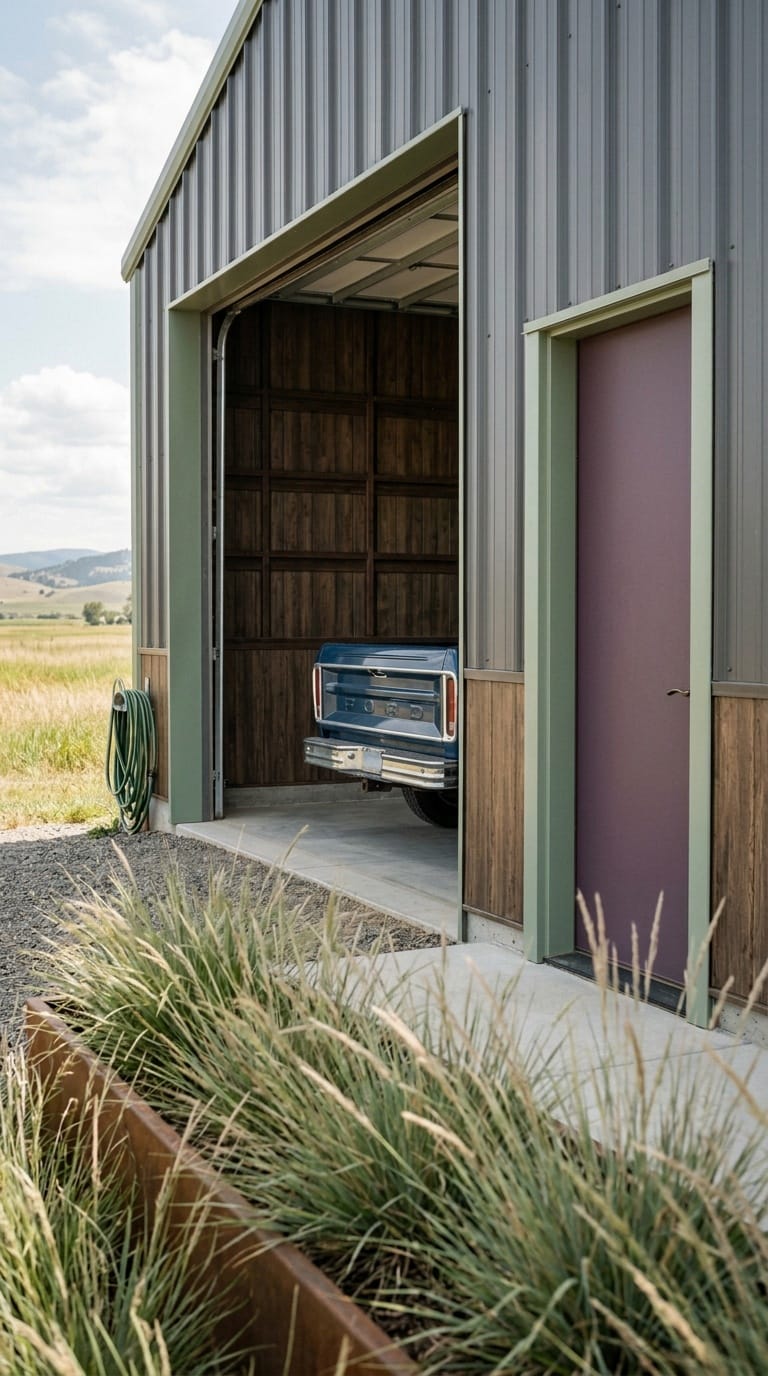
Start with the structure, not the skin. Pole barns are the cheapest barn garage to frame. The problem is they look like it. Two changes fix the whole thing: expose the steel frame in a color, and break the wall into panels instead of wrapping it in one sheet.
Best for: Budget builds on open rural lots where the garage stands alone.
Screenshot this material combo for the builder meeting.
Doors That Slide, Screen, and Disappear
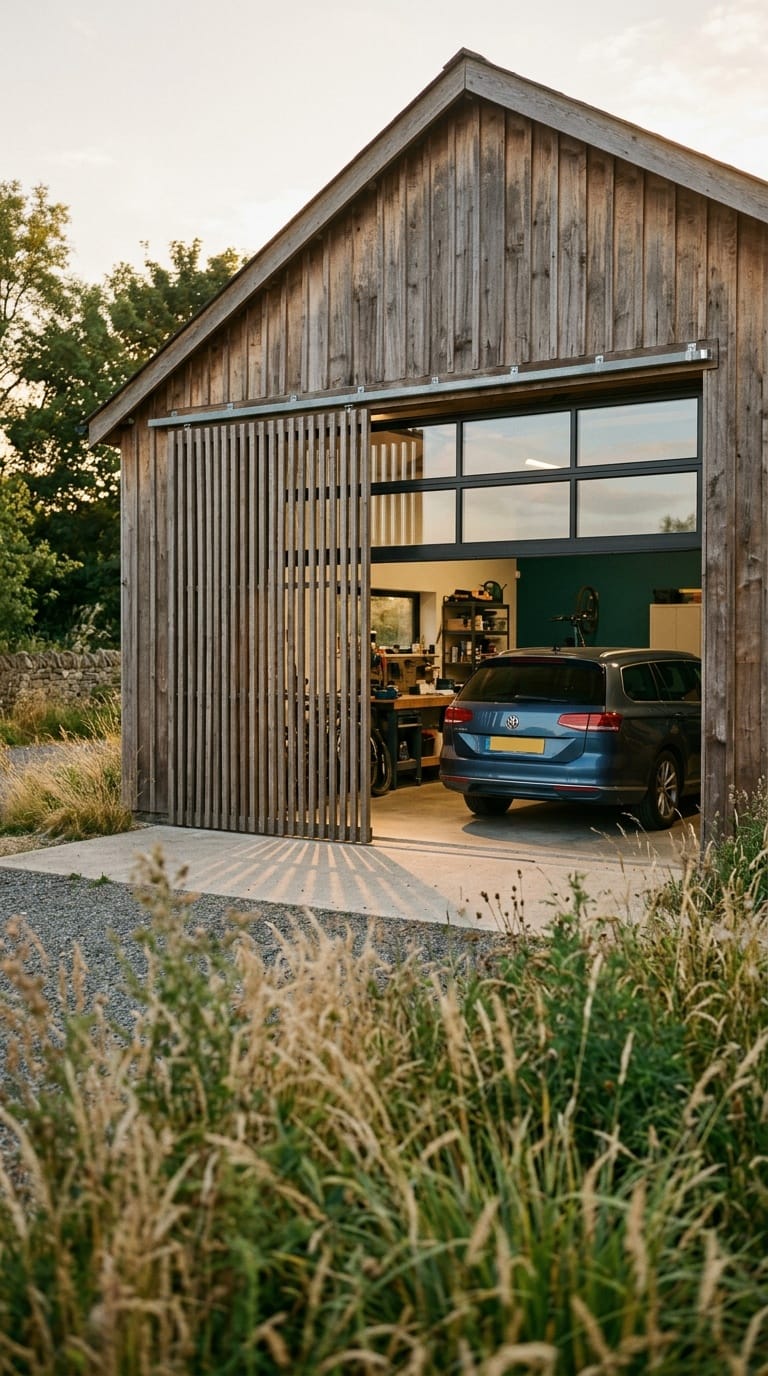
Full-height sliding timber screen in front of a glass layer. Open it halfway and the facade is half solid, half transparent. Close it and the garage looks like a barn wall. Pull it fully and you’re looking through floor-to-ceiling glass into the workshop.
What the Roof Actually Does to the Whole Look
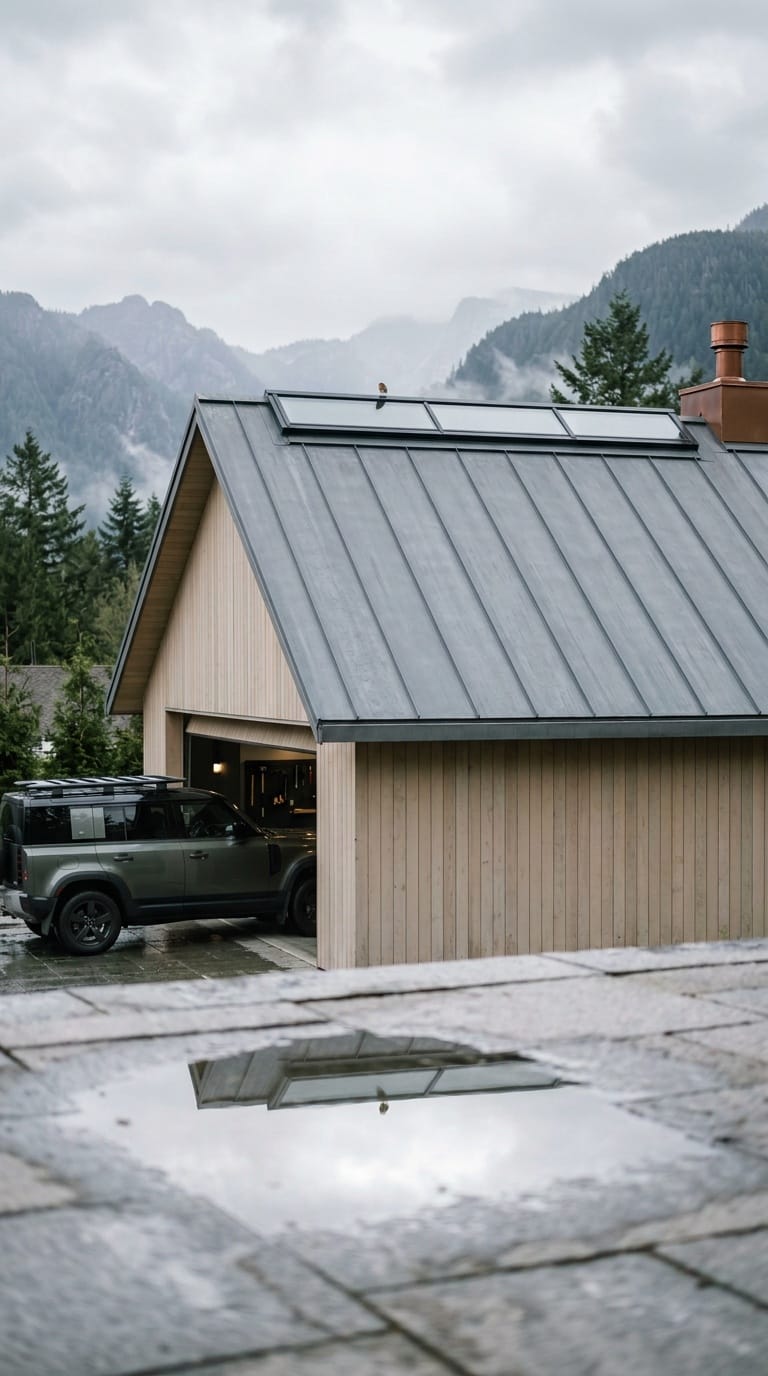
Zinc in soft graphite with matte patina. Concealed gutter at the eave keeps the line clean. Ridge skylight strip in dark frame along the apex. Galvalume in dull silver-grey if zinc is over budget. Even solar panel fields are landing on barn roofs now as flush dark planes. Zinc ages evenly over decades. Cheaper galvanized gets bright spots where rain concentrates. Never place corten directly above zinc runoff zones on the same facade. The staining ruins both.
Pro tip: Concealed gutters cost more but save the roof silhouette. Exposed gutters on a barn garage add visual noise at the one line everyone sees.
What Shows When the Doors Are Open
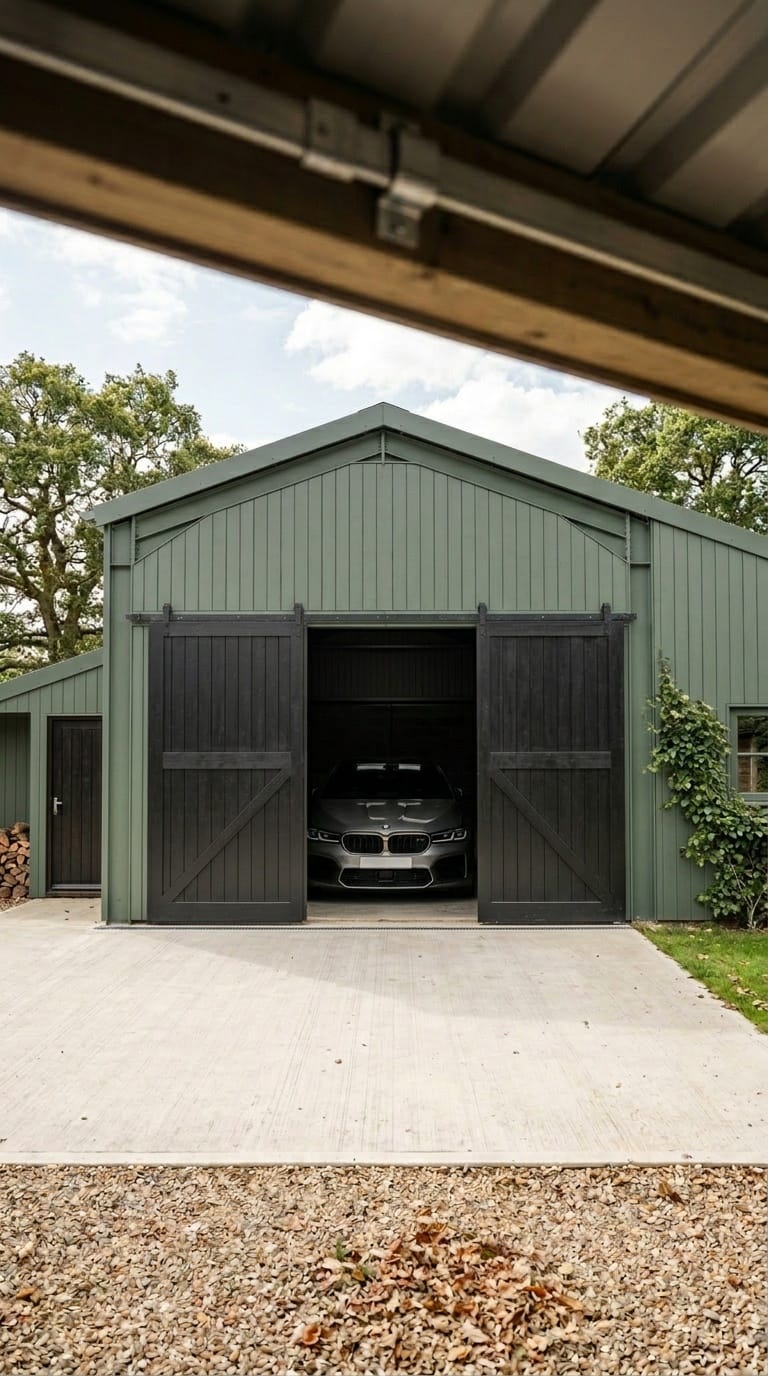
The doors slide open and the inside becomes the facade. Most barn garages show drywall, fluorescent strips, and pegboard. The ones worth keeping open treat the visible interior as a composed scene.
Living Above the Garage
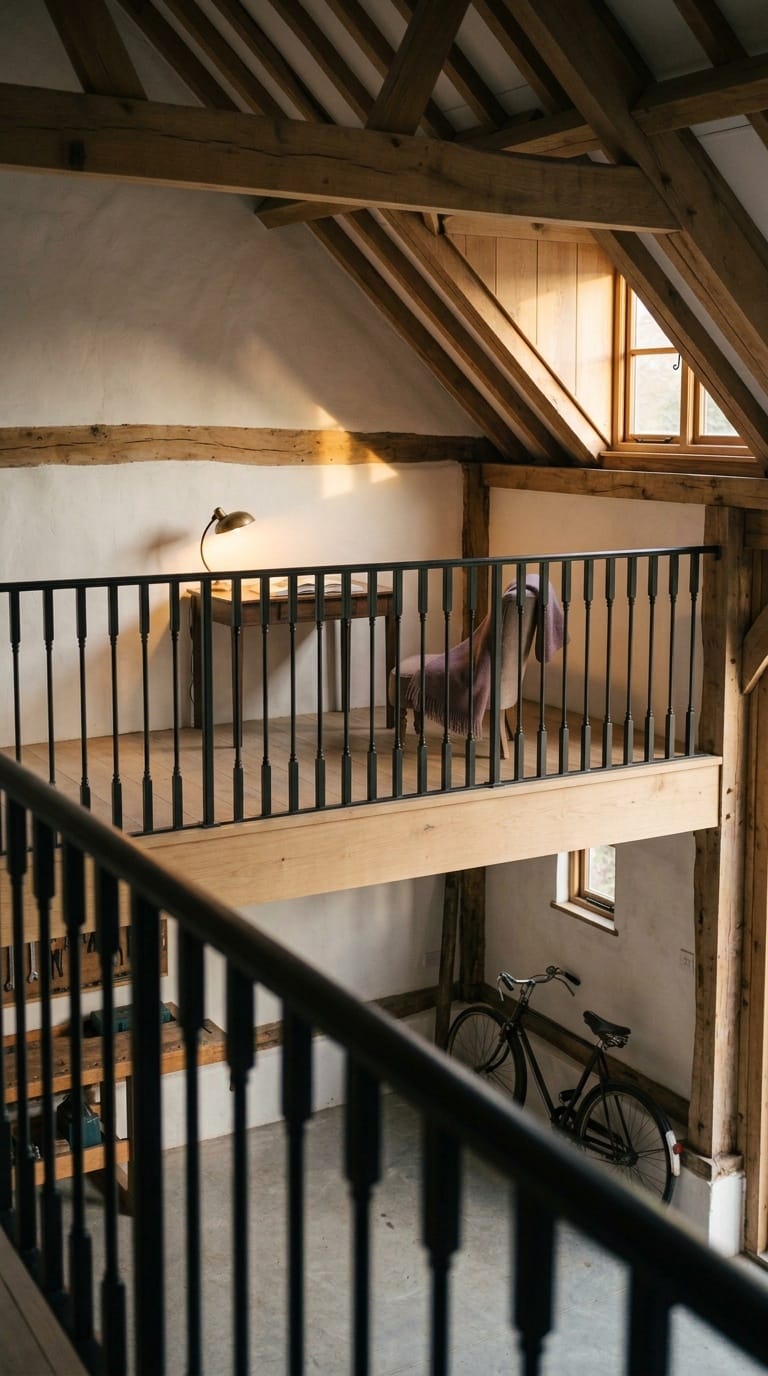
The mezzanine fits a study, guest spot, or studio without closing off the space below. Full living quarters push toward underfloor heating, air-source heat pump, and insulation from day one. The design decision is really about volume: keep the open span or divide it. Steel rail at the mezzanine edge, not solid wall. Close it off and the garage below feels like a basement.
Best for: Builds on tight lots where a second structure isn’t an option.
Lighting a Barn Garage After Dark
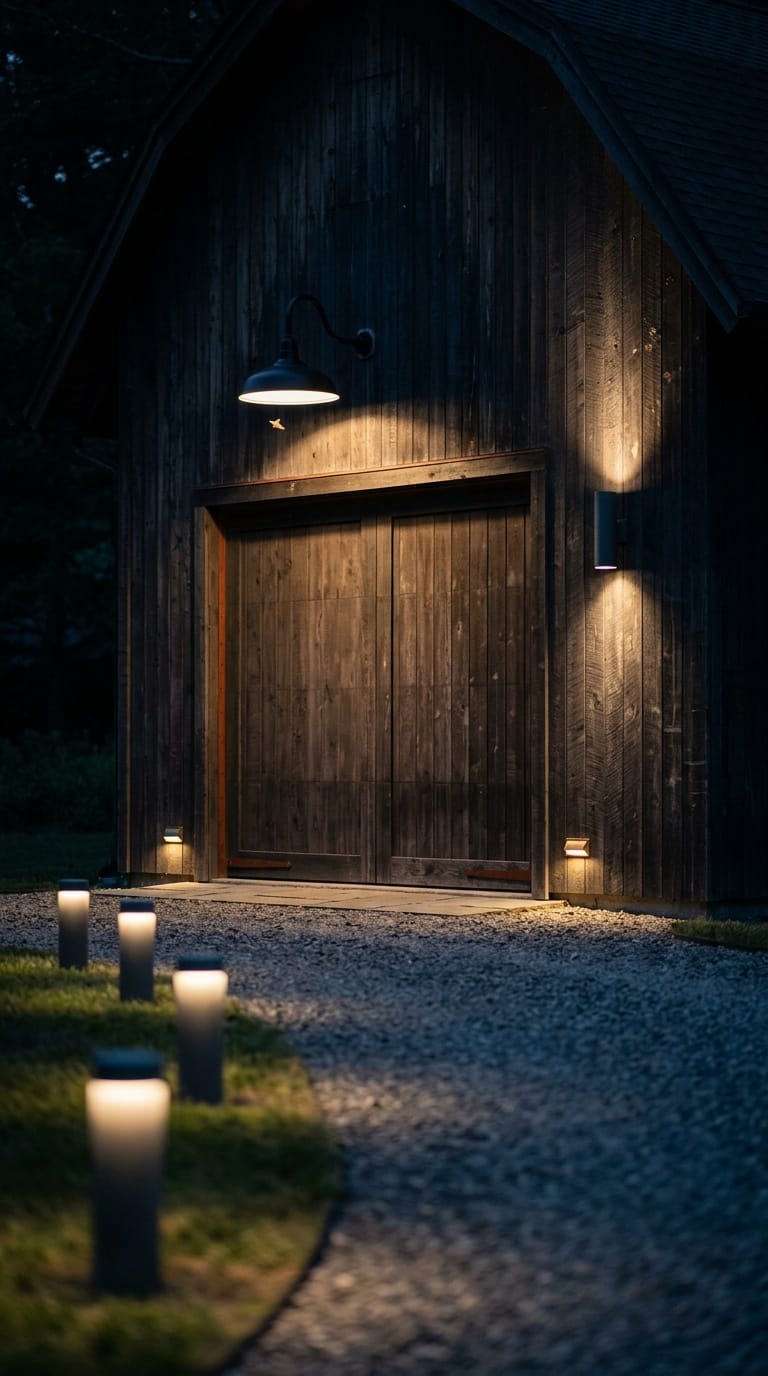
The oversized gooseneck survives because it’s been simplified. Bigger shade. Darker finish. It throws a focused pool downward and nearly disappears against a dark facade. This is the one barn fixture I’d actually keep. The uplights do the opposite: push light up the wall and turn flat siding into a texture map after dark. Path lights below knee height. Any higher and they compete with the building.
The Driveway and Everything Around It
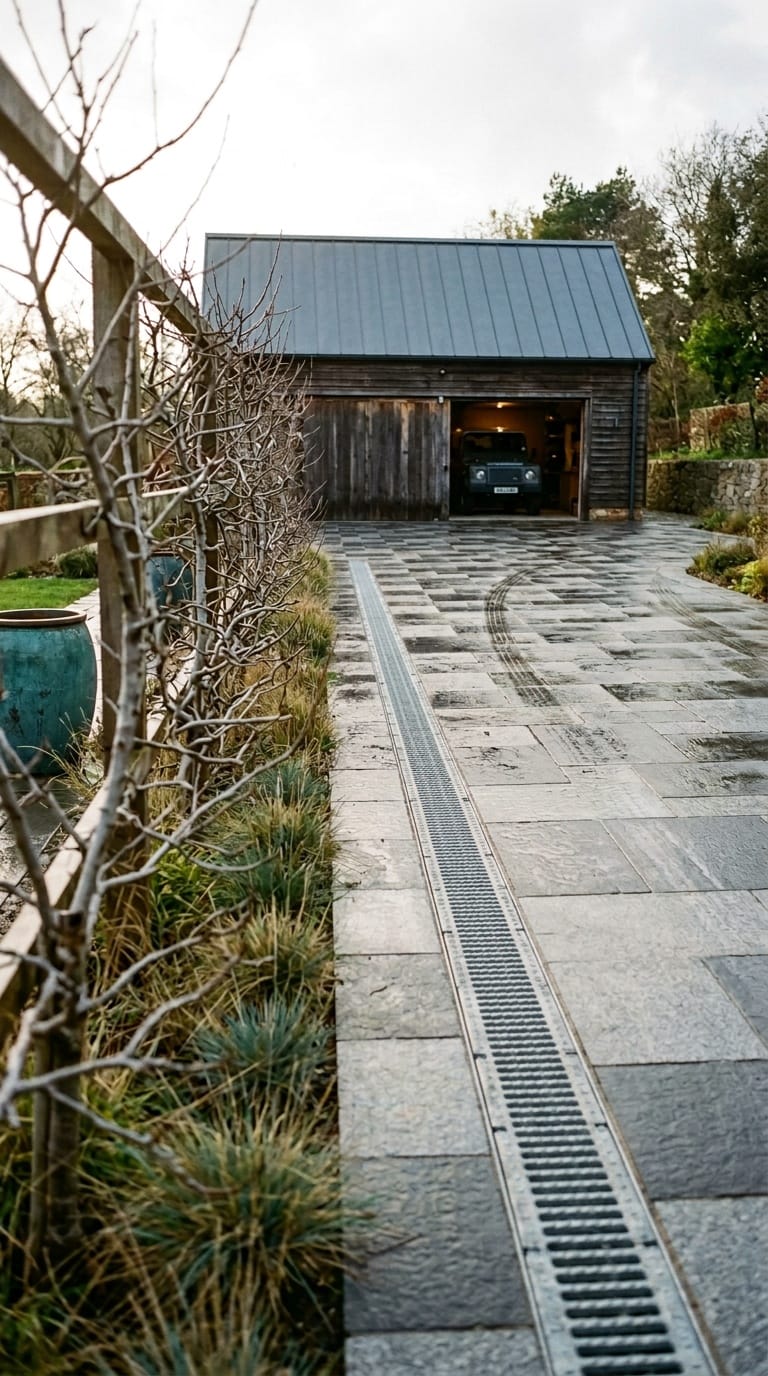
Granite pavers in mid grey to charcoal. Mixed honed and rough-cut surfaces. Corten drainage swale running the full drive length. Native grass drift at the border. Espalier fruit wall on the side boundary. Most people design the garage first and pour a slab for the rest.
Larger paving modules give the hardscape weight that concrete can’t match. Resin-bound gravel where the drive meets the planted edge creates a clean transition. Same thinking as a flagstone patio but scaled to a full driveway apron. A driveway edge becomes a design line when the material changes at the boundary. Gravel meeting stone, not gravel fading into lawn.